
The short answer
Get your AC checked if it blows warm air, short-cycles, freezes up, leaks water, or makes new noises. AllPro HVAC Services finds the actual cause, explains your repair or replacement options and the cost before starting work, and offers 24/7 emergency service in Los Angeles and nearby cities.
Air conditioners in Los Angeles work hardest when you need them most. Inland neighborhoods and the valleys run much hotter in summer than areas near the coast, and fall Santa Ana winds can bring hot, dry spells after summer seems over. AllPro HVAC Services repairs central air conditioners, heat pumps, and ductless systems for homeowners in Los Angeles and nearby cities. This page covers the warning signs to watch for, what our technicians check, how to decide between repair and replacement, what drives the cost, and what to expect when we come out.
Signs Your AC Needs Repair
Most AC problems give some warning before the system stops completely. If you catch them early, the repair is often smaller and parts that still work are under less strain. Schedule service if you notice any of these:
If you smell burning or the breaker trips more than once, turn the system off at the thermostat and leave it off until a technician has looked at it. Running it can turn a small electrical fault into a bigger one.
- Warm or barely cool air coming from the vents while the system runs
- Weak airflow in some rooms or across the whole house
- The system turns on and off in short bursts instead of running full cycles
- Ice on the refrigerant lines or the indoor coil
- Water pooling near the indoor unit, or a drain line that keeps backing up
- Grinding, squealing, banging, or loud buzzing from the indoor or outdoor unit
- A burning or musty smell when the AC starts
- The breaker trips when the outdoor unit kicks on
- Electric bills climbing even though you use the system the same way
- A thermostat reading that doesn't match how the house actually feels
What We Check During an AC Repair Visit
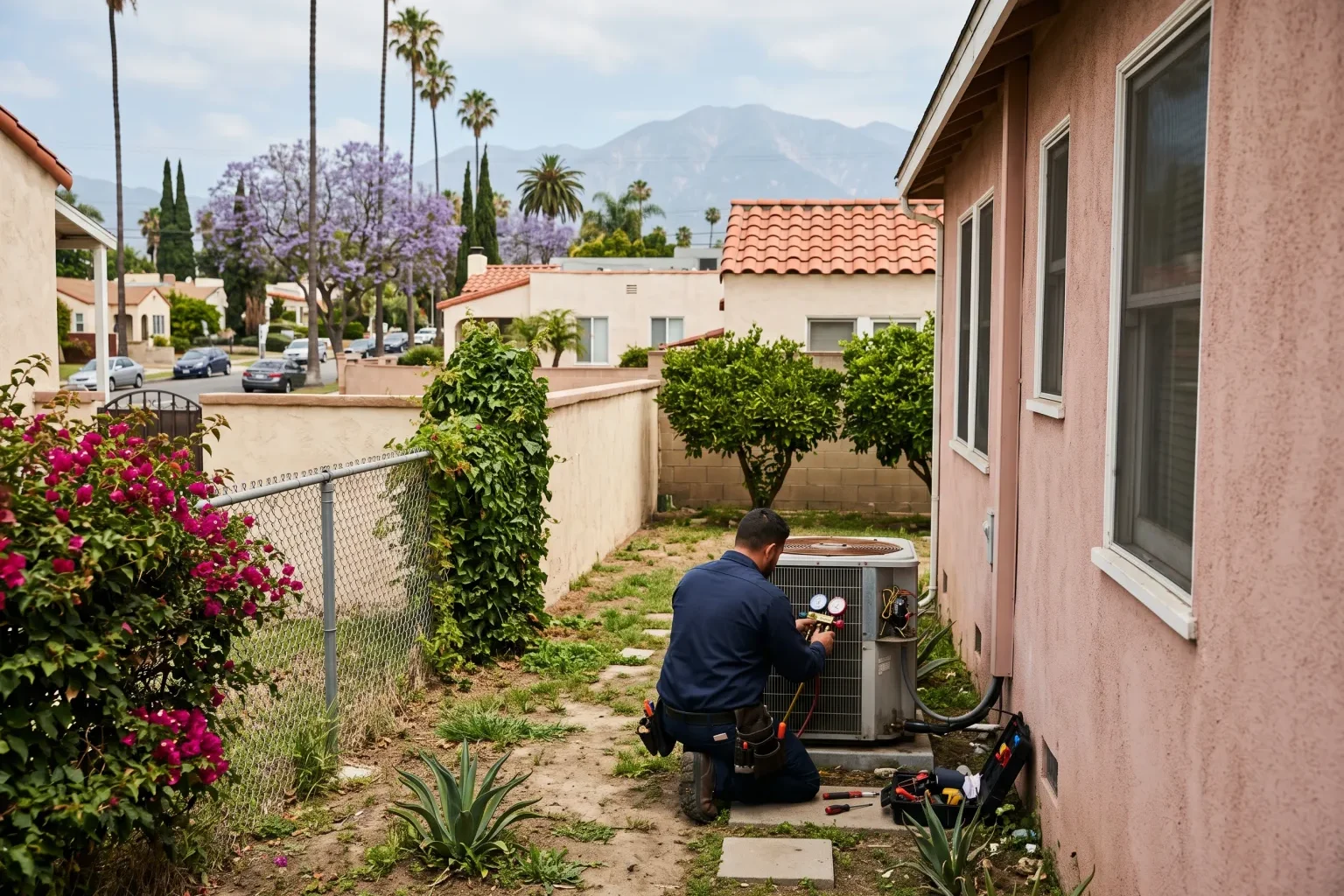
A good repair starts with finding the cause, not just treating the symptom. Poor cooling, for example, can come from a dirty filter, a failing capacitor, a refrigerant leak, or a blocked coil, and each one needs a different fix. Our technicians check the whole system so the repair solves the real problem.
Once we know what's wrong, we explain it in plain terms and show you what we found when we can. Then we walk you through your options before any work begins.
- Thermostat settings, wiring, and communication with the equipment
- Air filter condition and return airflow
- Electrical components, including capacitors, contactors, relays, and wiring connections
- Compressor and outdoor fan motor operation
- Indoor blower motor and blower wheel
- Refrigerant pressures and temperatures, and any signs of a leak
- Condition of the evaporator and condenser coils
- Condensate drain line, drain pan, and float safety switch
- Accessible ductwork connections, checked for obvious leaks or disconnections
Repair or Replace: How to Decide
Most AC problems are worth repairing. A failed capacitor, a clogged drain, or a worn fan motor is usually a straightforward fix on a system that still has plenty of life left. Replacement starts to make sense when the repair is major, when an older system keeps needing service, or when the system can't keep the house comfortable even when everything is working.
We'll give you an honest read on where your system stands. Together we look at the age and overall condition of the equipment, how often it has needed repairs, and whether a major part like the compressor or coil has failed. We also consider the type of refrigerant it uses and how well it handles your hottest days. The decision is yours. Our job is to give you the facts you need to make it.
If you do replace, consider a heat pump, because it handles both cooling and heating. LADWP residential electric customers can apply for Consumer Rebate Program rebates on qualifying heat pump systems. The rebate amount is based on the unit's SEER2 and HSPF2 ratings, and you apply after the equipment is purchased and installed, within 12 months of purchase. Many homes outside the City of Los Angeles are served by Southern California Edison instead, so the rebates available to you depend on which utility serves your address. We confirm the current offer before quoting it.
Two more things to know. The federal Energy Efficient Home Improvement Credit (25C) covered qualifying heat pumps placed in service before December 31, 2025, and it isn't available for new installations after that date. And if you're replacing a gas furnace as part of the project, South Coast AQMD Rule 1111 limits NOx emissions from natural-gas fan-type central furnaces in the region. The district has been amending the rule toward zero-emission requirements and sets and revises its compliance dates, so check the current rule before planning a furnace replacement.
What Affects the Cost of AC Repair
We price each repair based on what the system actually needs, which is why we diagnose first and quote second. The main factors are:
We give you the cost of the recommended repair before we start, and we ask before doing anything beyond it.
- Which part failed, since small electrical parts cost far less to replace than a compressor or coil
- Labor time, including how hard it is to reach equipment in an attic, crawlspace, closet, or tight side yard
- The refrigerant type and how much is needed, plus the time it takes to find and fix a leak
- Whether the parts for your brand and model are in stock or have to be ordered
- The system type, since heat pumps, ductless units, and packaged systems each have their own components
- Timing, if you need after-hours or emergency service
How an AC Repair Visit Works
Here's what to expect from your first call to the finished repair:
Before we arrive, clear a path to the indoor unit and the outdoor condenser, and make sure the air filter is easy to reach. If the system is iced over, switch cooling off and run the fan only so the ice can start melting.
- You contact us and describe what the system is doing. Details like strange noises, error codes, or when the problem started help us come prepared.
- We schedule a visit. For no-cooling situations and other urgent problems, we offer 24/7 emergency service.
- The technician inspects and tests the system to find the cause.
- We explain the problem, your options, and the cost before any work starts.
- With your approval, we make the repair, often during the same visit if the part is on hand.
- We test the system after the repair to confirm it's cooling properly, then clean up the work area.